

Mostbet Az Yükle Prosesi: Yeni Başlayanlar Üçün Qısa Bələdçi
Mostbet Az ️ Rəsmi Sayt Giriş Və Qeydiyyat
Logging into Bitstamp from the US: a practical, mechanism-first guide for traders
You sit at your desk before the market opens in New York. You want to move a portion of your USD into Bitcoin on a trusted venue, but you also need speed, regulatory safety, and certainty that your funds are accessible when you need them. That concrete sequence — authenticate, fund, execute, and withdraw — is a useful way to judge any exchange. For US-based traders, Bitstamp presents a particular bundle of trade-offs: solid regulatory posture and conservative product scope in exchange for a simpler trading surface than some high-leverage competitors. This article walks through how Bitstamp works for USD and BTC flows, what actually happens when you log in and trade, where the platform’s strengths and limits lie, and what to watch next.
Start with the login scenario because it reveals much of the platform’s operating logic. Bitstamp requires Two-Factor Authentication (2FA) for logins and withdrawals, and its user experience splits into Basic and Pro modes. Those two facts already tell you how the exchange balances simplicity with institutional robustness: Basic is friction-minimizing for straightforward buys; Pro gives you market depth, advanced charting, and order types for execution-sensitive trades. Below I unpack the mechanisms behind funding, custody, trade execution, and the security model so you can decide when Bitstamp fits your tactical needs.

How USD funding and BTC access function — the plumbing behind the click
Mechanically, moving USD into Bitstamp and then into Bitcoin involves three linked systems: the fiat rails, the internal custody ledger, and the exchange matching engine. In the US that fiat rail is ACH. ACH is cheap and familiar, but it is not instant; expect settlement latency and potential holds for first-time transfers. Bitstamp’s regional funding options are a feature: SEPA for Europe, Faster Payments for the UK, and ACH for US customers. If you prioritize immediacy, that matters — ACH has trade-offs between cost (low) and speed (slow compared with card rails or instant local networks).
Once your ACH credit clears, Bitstamp credits your USD balance on its internal ledger. This balance is what the exchange’s matching engine uses when you submit an order — it does not require on-chain movement until you withdraw crypto. That internal ledger model is standard across centralized exchanges and is efficient for high-speed trading. For traders who want to move USD into BTC quickly, a practical heuristic is: fund ahead of anticipated volatility when possible, and use instant fiat rails elsewhere if you need faster on-ramp.
When you place a buy order for Bitcoin on Bitstamp Pro, your order routes to a high-speed matching engine with options for market, limit, stop, and trailing stop. For institutional or algorithmic traders, Bitstamp offers FIX, HTTP API, and WebSocket integration. That implies lower latency and programmatic control if you automate execution. Retail traders using Pro get the same primitives but not the bespoke OTC desk used for large block trades.
Security and custody: what “95–98% cold storage” actually implies
Bitstamp reports storing roughly 95–98% of customer assets offline in cold wallets. Mechanistically, cold storage reduces attack surface: private keys are kept on devices that are air-gapped and guarded physically. The remaining hot funds enable withdrawals and market-making. This allocation is a design choice that balances liquidity against security. The trade-off is explicit: more assets offline increase safety but limit immediate withdrawal bandwidth; more hot liquidity improves speed but raises exposure to cyber risk.
Complementing custody are formal security practices: ISO/IEC 27001 certification and periodic SOC 2 Type 2 audits. Those are process-oriented signals that controls exist and are tested, but they are not guarantees against every threat. Certifications tell you that operational discipline is present; they do not eliminate all residual risk from human error, sophisticated attacks, or third-party failures. For US traders concerned about counterparty risk, a useful mental model is to treat exchange custody as operational custody for trading, not as equivalent to self-custody for long-term hodling.
Fees, order types, and what to expect when you execute
Bitstamp uses a maker-taker fee model starting at 0.5% for both makers and takers with tiered volume discounts. That base is higher than some zero-fee or ultra-low-fee venues that subsidize liquidity, but remember: fee level must be judged alongside liquidity, regulatory risk, and settlement reliability. If you are an occasional trader or dollar-cost averaging into BTC, the simplicity and regulated status might outweigh a few basis points in cost. For active traders, the volume tiers and access to FIX API can drive per-trade economics down.
The platform supports advanced order types (market, limit, stop, trailing stop), which means you can implement conditional strategies without external tools. However, Bitstamp is strictly a spot exchange: it does not offer margin, leverage, futures, or options. That limitation matters for anyone whose strategy depends on derivatives or leverage to hedge exposure. In exchange, Bitstamp reduces niche systemic risk associated with leveraged retail drawdowns and concentrated liquidation cascades that can affect orderbooks elsewhere.
Regulatory posture and US-specific considerations
Regulatory licensing is a practical feature for US traders. Bitstamp holds a BitLicense in New York and follows a regulated-first approach across jurisdictions. Licenses impose compliance costs on the exchange, but they also reduce regulatory tail-risk for users who prioritize legal clarity and banking connectivity. For US residents, that often means fewer surprises around fiat rails, identity verification, and withdrawal policies.
Still, licenses are not ironclad protections. They reduce business model risk but don’t eliminate counterparty risk or systemic market shocks. As a rule of thumb: prefer regulated exchanges if you need fiat on-ramps and bank relationships that align with US compliance expectations; prefer self-custody or a diversified custody mix for long-term holdings you do not intend to trade frequently.
Multichain USDC and withdrawal mechanics — options and implications
Bitstamp supports USDC across seven chains (Ethereum, Stellar, Solana, Optimism, Polygon, Avalanche, Arbitrum). That multichain support is operationally useful: you can choose a network that balances cost and speed for your withdrawal. Mechanically, on-chain withdrawal fees and finality differ by chain — Ethereum currently has higher gas costs but strong finality and infrastructure; Solana and Polygon are cheaper but have different centralization and reliability trade-offs. The practical implication: pick the chain whose cost, speed, and reliability profile match your needs rather than defaulting to the first option.
For BTC specifically, withdrawals go to the Bitcoin network and are constrained by block times and on-chain fees. If you intend to move coins frequently, factor withdrawal fees and settlement times into your cost model.
Where Bitstamp shines and where it breaks — a frank trade-off map
Strengths:
– Regulatory clarity and licenses that matter for US-based banking access.
– Mature custody practices and external audits.
– Simple product set that reduces complexity for retail traders.
– Institutional-grade APIs and an OTC desk for larger flows.
Limitations:
– No margin, leverage, or derivatives — this explicitly rules out certain strategies.
– ACH on-ramps are inexpensive but not instant; timing matters for volatile markets.
– Base maker/taker rates are not the lowest available if you are highly price-sensitive.
This set of trade-offs means Bitstamp is most attractive when your priorities are compliance, straightforward spot exposure to major assets (BTC, ETH, XRP, LTC, BCH, XLM), and operational reliability rather than ultra-low fees or leveraged products.
Decision-useful heuristics and a short checklist before you log in
Three quick, reusable heuristics:
1. If you need predictable fiat flows and US banking compatibility, favor Bitstamp; initiate ACH transfers ahead of anticipated trades.
2. If your strategy requires derivatives or leverage, don’t use Bitstamp as your primary execution venue.
3. For custody risk management, use Bitstamp for active trading balances and transfer long-term holdings to self-custody or insured custodians.
If you need the login link or want step-by-step guidance for account access, use the exchange’s official login resource: bitstamp login. That page is where you will manage 2FA setup and access Basic vs. Pro modes.
What to watch next — conditional signals, not predictions
Watch for three conditional signals:
– Changes in US banking integration or ACH rules: any tightening could slow fiat on-ramps and create deposit holds.
– Fee structure adjustments: consistent fee compression across exchanges could push Bitstamp to alter tiers to stay competitive.
– Broader regulatory shifts in the US around stablecoins or custody rules: these could affect how exchanges manage reserves and custody disclosures.
Each item is a mechanism: banking rules affect rails and settlement latency; fee competition affects liquidity and market maker behavior; regulation affects capital and operational costs. Any change in these levers will change the attractiveness of Bitstamp for different trader archetypes.
FAQ
Is Bitstamp safe for storing my Bitcoin long-term?
Bitstamp uses heavy cold storage (around 95–98% offline) and formal security certifications, which make it a safe operational environment for active trading balances. For long-term holdings, consider self-custody or an insured institutional custodian; exchanges are useful for liquidity and trading, not necessarily for indefinite custody of your largest positions.
How fast can I get USD onto Bitstamp from a US bank?
US customers use ACH for fiat deposits. ACH is low-cost but not instant; expect settlement delays, especially for first-time transfers. If you need immediate buying power, plan ahead or hold a small USD balance on the platform.
Can I use leverage or trade futures on Bitstamp?
No. Bitstamp operates strictly as a spot exchange and does not offer margin, leverage, futures, or options. If your strategy depends on derivatives, you will need a different venue or a hybrid approach.
Which chains should I use for withdrawing USDC?
Bitstamp supports USDC on Ethereum, Stellar, Solana, Optimism, Polygon, Avalanche, and Arbitrum. Choose based on fee, speed, and the receiving platform’s compatibility. Ethereum offers broad compatibility but usually higher fees; L2s and alternative chains can be cheaper but have different reliability and ecosystem trade-offs.
Safe Download Guide Intended For Android And Ios
Mostbet কিভাবে খুলবো: Navigating the User Interface
Mostbet Free Money: Legjobb Gyakorlati Tippek The Maximális Nyereséghez Entis”
Tendencias y control del campo de los casinos online en país en 2025
El mercado español de los casinos en línea ha llegado a tasas de expansión extraordinariamente altas. Respecto a su dinámica de desarrollo, solo es superado por Reino Unido, Alemania, Francia e Italia. Las secciones clave del ámbito incluyen los juegos de casino online y las apuestas deportivas. El crecimiento veloz no solo ha generado una subida considerable de los ingresos, sino también ha causado la emergencia de problemas regulatorios. A continuación, se revisan las tendencias clave, ventajas y desventajas vinculados al crecimiento del sector.
Estadísticas sobre el mercado español del iGaming y su posición en Europa
De acuerdo con la DGOJ, los ingresos del sector en 2024 fueron de 1.454 millones de euros, lo que supuso una subida del 17,6 % frente al GGR de 2023. A principios de 2025, la tendencia se mantuvo y el GGR alcanzó trescientos noventa y ocho coma uno millones de euros. Esto significa un incremento del 13,7 % en comparación con el año anterior.
Los números mostrados muestran la ampliación del ámbito de apuestas digitales, gracias a la elevación del público de clientes y a la multiplicación de los servicios. El crecimiento cada año del número de jugadores alcanzó el 21.6 %.
En el contexto del mercado europeo, el mercado de apuestas online en España todavía no ha llegado a su máximo potencial. Durante 2024, su porción era del 14 % del sector europeo. A modo de comparación, este número supera el 34 % en Suecia y en el Reino Unido. Esto significa que los casinos en línea españoles tienen espacio para crecer.
El crecimiento del sector se ve favorecido por la entrada constante de nuevos jugadores, y por la llegada de productos más variados. Los jugadores españoles tienen a su disposición casinos online, sitios de apuestas y productos nuevos. Un elemento crucial que afecta a esto es la mejora de la regulación, las inversiones realizadas y el incremento de la seguridad en las apuestas.
Desafíos para el crecimiento del mercado del iGaming en España
Aunque los juegos de azar son una forma muy entretenida de pasar el tiempo, pueden causar adicción. Esto es bien sabido por los operadores, pero no todos los jugadores son conscientes de los riesgos.
Para algunas personas, la dependencia del juego puede ser un problema serio. Esto otorga una responsabilidad a los operadores, que tienen que restringir las apuestas según ciertos indicadores.
También, todos los casinos en línea deben promover el juego responsable y brindar herramientas para su uso. Para enfrentar este problema, se han creado servicios de prevención de la adicción al juego.
Descubre cuáles son los mejores casinos online disponibles para jugadores argentinos en .
Dificultades de regulación
El sector de casinos en línea en España se enfrenta a una oleada de ofertas ilegales. Frecuentemente son sitios web ubicados fuera de la UE, del mercado negro. Estos sitios atraen a los usuarios con bonos competitivos y brindan una más amplia variedad de juegos. Sin embargo, no cumplen todas las medidas de seguridad requeridas y no contribuyen con impuestos. Las autoridades legislativas en España están actuando para solucionar este problema, reforzando las normativas.
Regulación y licencias de casinos online en España
El ámbito en expansión de casinos online en España demanda una regulación rigurosa. Diariamente, miles de apostadores visitan páginas de casinos en línea, plataformas de apuestas y salas de póquer. Detrás del funcionamiento de las páginas de juegos de azar se encuentra una compleja estructura legal que salvaguarda la seguridad de los usuarios.
El juego en línea en España mantuvo un estatus neutral hasta 2011, año en que se implementó la Ley 13/2011 sobre la regulación de los juegos de azar. Hasta ese punto, no existía una prohibición directa de los juegos de azar, por lo que muchos operadores ofrecían sus servicios sin restricciones.
Tras la entrada en vigor de la ley, se creó en España un marco jurídico que asegura la transparencia y el apoyo al juego responsable en este sector.
La Ley 13/2011 estableció la obligación de obtener una licencia para todas las empresas que ofrecen servicios en el país. Adicionalmente, se desarrollaron mecanismos para prevenir la adicción al juego y combatir el fraude.
A partir de su implementación de esta ley, el sistema jurídico ha evolucionado varias veces con el fin de adaptarse a las variaciones del sector. Se introdujeron controles más estrictos relacionadas a la divulgación de promociones hacia los usuarios y prohibiciones a varios tipos de juegos de azar. Estas disposiciones estaban relacionadas sobre todo con proteger de los niños.
La DGOJ pasó a ser en la autoridad principal controlador del juego digital en el país. Se ocupa de asegurar el cumplimiento de todas las normativas y supervisa la concesión y revalidación de licencias legales.
Principales tendencias de desarrollo de los casinos en línea en España
En los últimos diez años, el sector de los casinos online ha transformado considerablemente gracias a la introducción de nuevas tecnologías. Tendencias clave en juegos para 2025:
- Personalización del juego. Las plataformas diversifican los juegos y adaptan los programas de fidelización a las expectativas del público.
- Inteligencia artificial y automatización. Los procesos de registro, chequeo, pago y otros se han simplificado y clarificado.
- Juegos en móviles. En la nación, los casinos en línea móviles se han convertido en una parte integral de la vida de los jugadores. Las apuestas móviles son más cómodas y accesibles siempre.
- Dimensión social. Los jugadores prefieren las competiciones con otros usuarios, y las apuestas individuales son menos prioritarias.
1inch anmelden, 1inch login und wie der DEX-Aggregator wirklich funktioniert
Viele Nutzer glauben, dass „den besten Preis bekommen“ bei DEXs einfach eine Frage des Klicks ist: Wallet verbinden, Swap auswählen, fertig. Das ist eine nützliche Vereinfachung – aber irreführend. Bei Aggregatoren wie 1inch steckt hinter dem sichtbaren Swap eine Reihe ökonomischer, algorithmischer und sicherheitsrelevanter Entscheidungen, die bestimmen, ob Sie wirklich den günstigsten Marktpreis, minimale Slippage und akzeptables Risiko erhalten.
Dieser Text richtet sich an deutschsprachige DeFi-Nutzer, die 1inch als DEX-Aggregator nutzen oder sich registrieren (anmelden / login) möchten. Ich erkläre Mechanismen wie Pathfinder-Routing und Fusion Mode, benenne konkrete Grenzen (z. B. Abhängigkeitsrisiken und Freigaben), und gebe praktische Heuristiken, die Sie sofort anwenden können — inklusive eines Hinweises zur Ledger-Integration, die diese Woche angekündigt wurde.
Wie 1inch funktioniert: Mechanik statt Marketing
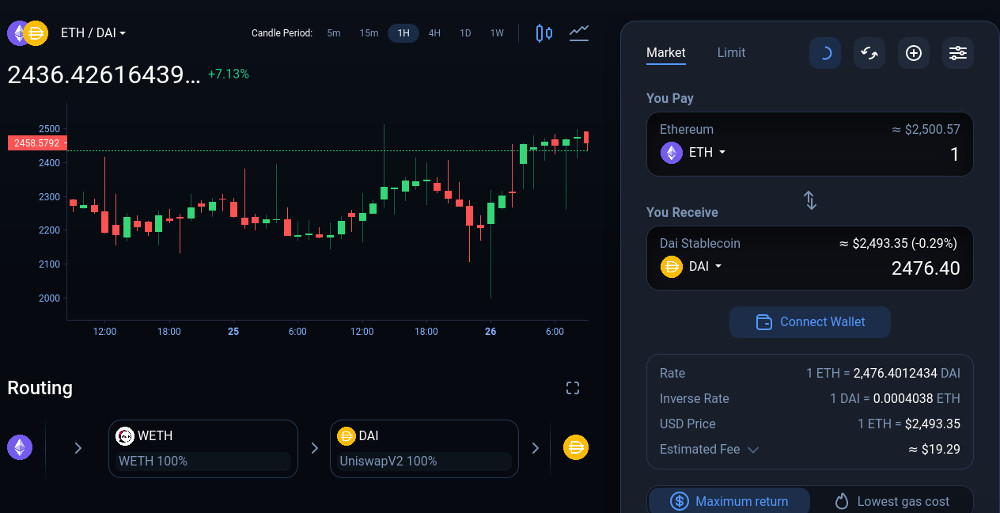
1inch ist ein dezentraler DEX-Aggregator: technisch bedeutet das, dass es keine eigene Order-Books mit Verwahrung gibt, sondern ein Router-System, das Liquidität von über 400 Protokollen bündelt. Der Kernmechanismus ist der Pathfinder-Algorithmus. Er analysiert in Echtzeit Liquiditätstiefen, Preise und Gasgebühren über mehrere Ketten und DEXs und teilt größere Orders oft auf mehrere Pools auf, um Slippage zu reduzieren. Mechanistisch betrachtet ist das ein Optimierungsproblem: Minimierung von erwarteter Slippage + Fees unter Gas- und Reorg-Risiken.
Zwei Modi sind für Nutzer besonders relevant: klassische On-Chain-Routing-Swaps und der Fusion Mode. Im Fusion Mode sendet der Nutzer ein Trade-Intent an das 1inch-System; professionelle Market Maker (Resolver) konkurrieren off-chain um die Ausführung und bezahlen die Gasgebühren — der Trade erscheint nicht im öffentlichen Mempool. Das reduziert MEV-bedingtes Front-Running und Sandwiching (Miner Extractable Value), weil Angreifer keinen einfachen Mempool-Zugriff haben.
Sicherheits- und Benutzer-Risiken: Was oft übersehen wird
Ein verbreiteter Fehler ist zu denken, dass „non-custodial“ automatisch gleichbedeutend mit „risikofrei“ ist. 1inch ist non-custodial: Sie handeln direkt aus Ihrer Wallet, keine KYC, keine Einzahlungen auf zentrale Konten. Trotzdem erbt der Aggregator Risiken der angebundenen DEXs und Smart Contracts (z. B. Uniswap, Curve). Ein exploitierter Pool oder fehlerhafter Router-Vertrag auf einer angebundenen Plattform kann indirekt Ihr Asset gefährden.
Ebenso kritisch: Token-Freigaben. Viele Nutzer erlauben „unbegrenzte Freigaben“ (Infinity Unlocks). Wenn ein externer Vertrag kompromittiert wird, kann das zur vollständigen Entnahme Ihrer Tokens führen. Die etablierte Gegenmaßnahme ist praxisorientiert: erteilen Sie Single-Swap-Freigaben für genau den benötigten Betrag oder verwenden Sie Tools, um Freigaben nach dem Swap zurückzunehmen.
Ledger-Integration: Praktische Auswirkung für deutsche Nutzer
Diese Woche gab es eine relevante Entwicklung: Ledger führt One-Click-DApp-Konnektivität für 1inch ein. Praktisch bedeutet das, dass Transaktionsdetails direkt auf dem Ledger-Display erscheinen — ein konkreter Schutz gegen Phishing und Blind-Signaturen. Für Nutzer in Deutschland, die Hardware-Wallets bevorzugen, reduziert diese Integration die Vertrauensoberfläche erheblich: Sie müssen nicht auf Browser-Extensions vertrauen und sehen die zu signierenden Parameter physisch bestätigt.
Das ist kein Allheilmittel: Die Ledger-Integration schützt vor fehlerhaften Signaturen und externen Phishing-Versuchen, nicht jedoch vor smart-contract-basierten Abhängigkeitsrisiken oder Front-Running in On-Chain-Mempools (wenn Sie nicht den Fusion Mode nutzen). Sie ist aber ein starker praktischer Hebel für Sicherheitsbewusste, die geringe UX-Friktion mit robusten Signatur-Prüfungen verbinden möchten.
Trade-offs: Fusion Mode vs. klassisches Routing
Fusion Mode reduziert MEV-Risiken, bietet gasgebührenfreie Swaps (die Resolver übernehmen Gas) und ermöglicht oft bessere effektive Preise für Retail-Trades. Der Trade-off ist: Sie verlassen sich auf ein Wettbewerbssystem von Resolvers; es besteht ein Abhängigkeits- und Governance-Aspekt. 1INCH-Token-Inhaber haben Utility- und Governance-Rechte, einschließlich Einfluss auf die Auswahl von Resolvern durch Staking. Das bringt Anreize, kann aber auch zu Machtkonzentrationen führen, wenn große Stakeholder dominieren.
Beim klassischen Routing sehen Sie transparente on-chain Pfade, die unmittelbar reproduzierbar sind. Hier zahlen Sie Gas, sind aber völlig on-chain-verifizierbar und erben das volle MEV-Risiko — außer Sie ergreifen zusätzliche Schutzmaßnahmen (z. B. private RPC oder Flashbots). Für große Trades kann das klassische Routing mit Split-Orders sinnvoller sein, weil Pathfinder aktiv Slippage minimiert; für kleinere Trades ist Fusion häufig günstiger.
Praktische Heuristiken für Anmeldung (anmelden) und Login
1inch besitzt keine zentrale Benutzer-„Registrierung“ im klassischen Sinne — Ihr Login ist die Verbindung Ihrer Wallet (MetaMask, Ledger, Coinbase Wallet, u. a.). Das ändert die Sicherheitsdynamik: statt Passwortschutz müssen Sie Wallet-Schutz und Freigabenkontrolle priorisieren. Konkrete Schritte:
1) Verbinden Sie eine Hardware-Wallet für größere Beträge; nutzen Sie Ledger-Integration, wenn verfügbar. 2) Erteilen Sie nur Single-Swap-Freigaben für Tokens, die Sie gerade handeln. 3) Prüfen Sie Routings und erwartete Slippage im Interface, bevor Sie signieren. 4) Nutzen Sie Fusion Mode, wenn Sie MEV-Risiken vermeiden wollen und Ihrem Resolver-System vertrauen. 5) Behalten Sie Abhängigkeitsrisiken im Blick: große Liquiditätspools können tiefe Preise bieten, bringen aber externe Smart-Contract-Risiken mit.
Wenn Sie konkrete Login-Anweisungen oder eine Schritt-für-Schritt-Hilfe für den 1inch-Dex-Login suchen, finden Sie eine praktische Anleitung hier: https://sites.google.com/kryptowallets.app/1inch-dex-login/
Wo 1inch stark ist — und wo Vorsicht geboten ist
Stärken: Umfangreiche Liquiditätsaggregation (400+ DEXs), fortgeschrittene Routing-Algorithmen, Fusion- und Cross-Chain-Funktionen (Fusion+, Bridge) und ein intensives Audit-Programm. Diese Merkmale bedeuten in der Praxis oft bessere Preise und niedrigere Slippage für vielfältige Paare und Ketten.
Grenzen und offene Fragen: 1) Abhängigkeit von Dritt-DEXs — Sicherheitsprobleme dort werden zu Ihren Problemen. 2) Governance-Effekte — Token-basierte Macht kann zentralisierende Wirkungen haben. 3) Fusion-Ökonomie — die Nachhaltigkeit des Modells, bei dem Resolvers Gas tragen, hängt von Marktanreizen und 1inch-Token-Mechanismen; das ist plausibel, aber nicht garantiert langfristig stabil.
Entscheidungsrahmen: Wann 1inch wählen?
Nutzen Sie 1inch, wenn Ihr Ziel ist: bestmögliche durchschnittliche Ausführung über mehrere Märkte hinweg, häufige Cross-Chain-Transfers, oder MEV-geschützte Swaps via Fusion. Wählen Sie klassisches Routing, wenn Sie maximale On-Chain-Transparenz wünschen oder komplexe große Trades ausführen, bei denen direkte Pool-Fragmentierung sinnvoll ist.
Eine einfache Daumenregel für deutschsprachige Nutzer: Hardware-Wallet + Single-Swap-Freigaben + Fusion Mode für Retail-Trades; für institutionell größere Orders: klassische On-Chain-Routing-Strategie mit Split-Orders und, falls verfügbar, private Bundling/Flashbots-Pipelines prüfen.
FAQ
Muss ich mich bei 1inch anmelden, um zu traden?
Nein im klassischen Sinne. „Anmelden“ bedeutet Wallet verbinden (z. B. MetaMask, Ledger, Coinbase Wallet). Es gibt keine zentrale Kontoregistrierung mit E-Mail/KYC für grundlegende Swaps; Sicherheit hängt von Ihrer Wallet und Freigaben ab.
Schützt Fusion Mode vollständig vor MEV-Attacken?
Fusion Mode reduziert MEV-Risiken erheblich, weil Trades nicht im öffentlichen Mempool landen; er eliminiert sie aber nicht vollständig. Es bleiben Abhängigkeiten von Resolvers und Governance-Anreizen sowie potenzielle wirtschaftliche Arbitragemöglichkeiten außerhalb der Mempool-Angriffe.
Wie vermeide ich das Risiko unbegrenzter Token-Freigaben?
Erteilen Sie nur Single-Swap-Freigaben für den benötigten Betrag oder verwenden Sie Wallet-Funktionen/Tools, um Freigaben nach dem Swap zurückzunehmen. Das ist eine einfache, aber wirksame Präventionsmaßnahme gegen kompromittierte Verträge.
Welche Blockchains unterstützt 1inch?
1inch aggregiert Liquidität über viele Netzwerke: Ethereum, Polygon, Arbitrum, Optimism, BNB Chain, Base, Avalanche, zkSync und Solana sind darunter. Cross-Chain-Funktionen wie Fusion+ und die 1inch Bridge ermöglichen Transfers zwischen Netzwerken.
Abschließend: 1inch bietet technisch überzeugende Mechanismen, die echten Mehrwert liefern — aber der Nutzererfolg hängt von operativen Entscheidungen (Walletwahl, Freigabepraxis), Verständnis der Trade-Offs (Fusion vs. On-Chain) und Awareness für externe Risiken ab. Wer diese Mechanismen kennt und praktisch anwendet, erhöht die Wahrscheinlichkeit, dass „bester Preis“ nicht nur ein Versprechen bleibt, sondern ein zuverlässiges Ergebnis.
Versi web 2025
Platform kami sendiri menjamin bahwa semua transaksi, dan potensi pengembalian dana, ditangani secara legal dan aman, dengan menjaga prosedur transparan yang melindungi kepentingan pemain. Akun uji coba di Fortunate Spray memungkinkan pemain untuk terlibat sepenuhnya dalam permainan tanpa harus mengeluarkan uang. Continuar leyendo “Versi web 2025”
